You can analyze user interviews with AI assistants like Claude or ChatGPT and still keep your evidence intact. The trick is to use the assistant to find and organize evidence, not to hand you conclusions.
This post walks through each of the habits that keep evidence organized and why they matter.
What gets lost when we hand evidence to AI assistants?
If you run research, you probably already do some of your synthesis in a chat window. AI is decent at spotting patterns across long text, and it lets you ask follow-up questions in plain language instead of re-tagging a spreadsheet.
The usual workflow looks like this: export a transcript from your research tool, paste it into the assistant, ask for themes, repeat for the next interview. By the end of the afternoon you have a tidy list of themes and a handful of strong-sounding quotes.
What you have lost is harder to see. The quotes have come loose from their timestamps. Speaker labels may have been flattened or dropped when you copied the text. The recording itself is still sitting in the research tool, disconnected from the chat where the thinking happened.
That's why when it's time to include clips as evidence you are back to scrubbing through video trying to find the moment.
The further a quote travels from its source, the easier it becomes for a paraphrase to pass as a quote or unintentionally dilute the meaning.
How do you prompt for evidence instead of conclusions?
The single most useful change is to stop asking the assistant what users think and start asking it to show you what users said.
Compare two prompts. The first:
What are the main frustrations participants had with onboarding?
The second:
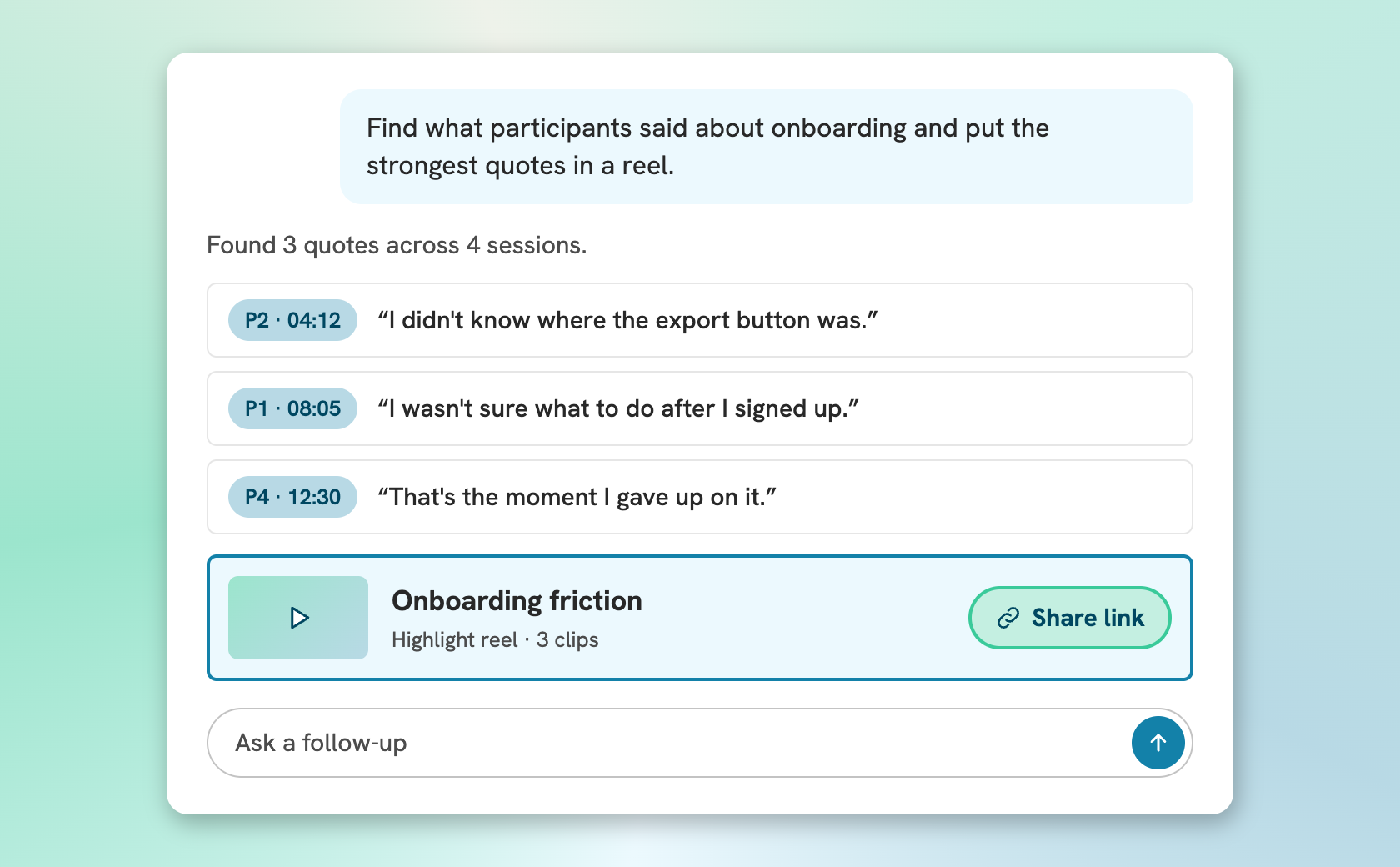
Find every moment where a participant describes a frustration with onboarding. For each one, give me the exact quote, the speaker, and the timestamp. Do not summarize or paraphrase.
The first prompt invites the assistant to synthesize, which means compressing, smoothing and filling gaps. The second keeps it in the role of a search tool with good reading comprehension. You still get to see patterns, but you see them through raw material you can verify.
A few habits that help:
- Always ask for speaker and timestamp. If the assistant cannot give you both, treat the quote as unverified.
- Ask for exact wording. Say explicitly that you want verbatim text, not a cleaned-up version.
- Ask for counterexamples. Once a theme emerges, ask for moments that contradict it. This is the fastest way to check whether a pattern is real or just loud.
- Separate finding from interpreting. Run one pass to gather quotes, then a separate pass where you reason about what they mean. Mixing the two is where evidence quietly turns into narrative.
How narrow should each analysis be?
It is tempting to throw every interview you have into one conversation and ask for the big picture. Resist it.
Different studies have different research questions, different participant profiles and different interview guides. Assistants with contextual memory are bad at separating this week's pricing in a churn study from the last week's discovery study, which is why quotes can accidentally be attributed to the wrong study or speaker.
Narrowing your query to a single project or workspace makes your prompts sharper. "What did this participant say about switching tools?" is a question an assistant can then answer precisely.
Why check every quote against the recording?
Because transcripts and assistants both make mistakes, and the deck is where those mistakes become decisions.
Transcription can mishear a word that flips the meaning of a sentence. Transcripts can swap the interviewer and the participant. An assistant can stitch together two nearby sentences into one cleaner quote.
This step is also where timestamps help. If every quote came back with a speaker and a time, checking is a matter of jumping to the right moment. If it did not, checking means hunting, and hunting is the step people skip when the deadline is close.
How do you keep the reel next to the finding?
This is the part of the workflow where copy-and-paste falls apart: the evidence lives in one tool, the reasoning lives in another, and the connection between them lives in your memory.
Clipses turns research interview footage into searchable transcripts and shareable highlight reels, and it connects to Claude and ChatGPT as an MCP connector at https://api.clipses.ai/mcp. Once it is connected, the assistant works with your recordings directly instead of with whatever text you pasted in.
From the assistant, you can list your projects and recordings and read full transcripts with speakers and timestamps intact. The assistant searches a project the same way the Chat tab in Clipses does, and it can narrow a search to one recording or one speaker. That maps directly onto the habits above: one project at a time, one participant when a theme needs it, and every quote arriving with who said it and when.
When a set of quotes supports a finding, the assistant can create a playlist and add those quotes to it as clips. It can then render a reel and return a share link you can share. It can also change a clip's speed inside a reel. The share link is what goes in the deck next to the finding, so anyone who doubts a claim can watch the moments it rests on.
A few practical details worth knowing:
- Searches run from an AI assistant are free and don't use Clipses AI credits.
- New footage: the assistant can import a video from a public Google Drive link.
- Team setup: on Claude Team and Enterprise, a workspace Owner has to add the connector before members can use it.
To be clear about what this is: it gets your interview footage and the clips that support a finding into the same conversation where you are doing the thinking. It is not a research repository, and it does not decide what your findings are.
What stays human?
Deciding what the evidence means.
An assistant can find every moment a participant mentioned a workaround. It cannot tell you whether that workaround is a sign of a missing feature, a sign of a power user who will never be satisfied, or a sign that your recruiting skewed toward one kind of customer. That judgment depends on what you know about the product, the market, the study design and the people in the room. None of that is in the transcript.
The same goes for weighting. Three mild complaints and one furious one are not a simple tally. Which matters more depends on who said it, what they were trying to do, and what the team is about to decide. Those are research calls, and they are yours.
When every claim in your readout links back to the moment it was said, the conversation shifts from "do we believe this?" to "what do we do about it?" That is a better conversation, and it is one the researcher should be leading.